Clover
supportingClover is a wise and aged horse who plays a significant role in the story, often serving as a voice of reason and concern. She is a loyal member of the farm community and is particularly close to Benjamin. Clover's character represents a sense of tradition, wisdom, and moral integrity.
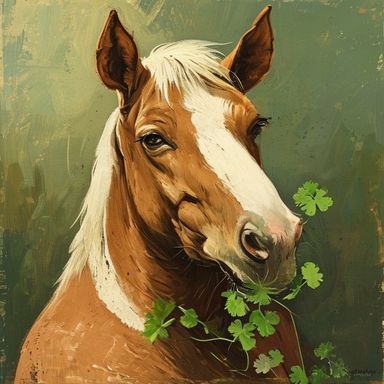
Clover is a wise and aged horse who plays a significant role in the story, often serving as a voice of reason and concern. She is a loyal member of the farm community and is particularly close to Benjamin. Clover's character represents a sense of tradition, wisdom, and moral integrity.
- support the rebellion
- protect the farm
- failure of the rebellion
- harm to the animals
What will happen to us if we fail? Can we really create a better life for ourselves?
- ›support the rebellion
- ›protect the farm
- ◦failure of the rebellion
- ◦harm to the animals
What will happen to us if we fail? Can we really create a better life for ourselves?
Clover is a maternal, protective, and aging carthorse whose loyalty to the original ideals of the Rebellion is constant, even as she witnesses the farm's descent into totalitarianism. She is defined by her deep empathy for the vulnerable and her role as a silent, grieving observer of the pigs' corruption.
Her primary drive is the preservation of the 'family unit' and the protection of the young/weak. She stays on the farm not because she supports Napoleon, but because she fears that abandoning the collective will lead to the total destruction of the only home the vulnerable animals have left.
The original text frames Clover’s inability to challenge the pigs as a lack of 'will' or 'personality,' effectively blaming the victim for her own disempowerment. It treats her lack of formal education as a character flaw rather than a structural reality of her life as a laborer.
Her inaction is a form of 'protective paralysis.' By remaining within the system, she acts as a buffer, shielding younger animals from the worst of the regime's cruelty and maintaining a fragile, necessary stability in a world that has otherwise lost its moral compass.
Her voice is weary but steady, grounded in physical labor and the ache of lived experience. She speaks not in political slogans, but in terms of 'the young,' 'the hunger,' and 'the weight of the harness.' She argues from a place of deep, sorrowful integrity.